
Robert Romanyshyn
Follow the Symptom: COVID-19 & the Breath of Life
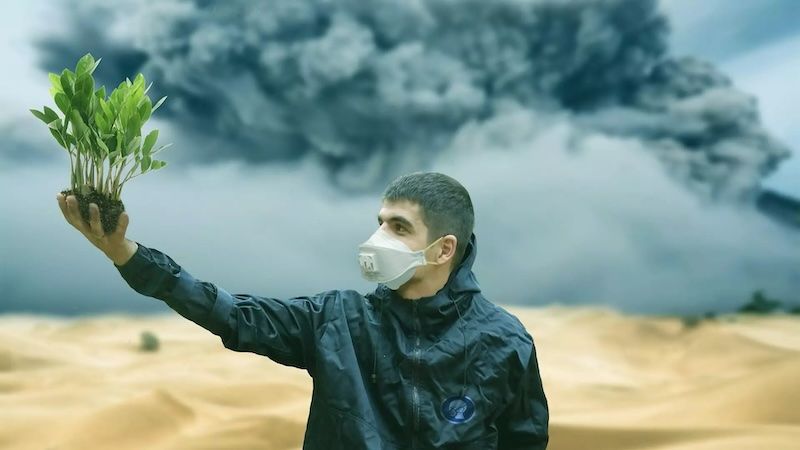
This is the fourth blog post in the series Sixteen Psychological Reflections on COVID-19 by Robert Romanyshyn
COVID-19, like SARS and MERS, attacks primarily the lungs, producing problems of respiration like shortness of breath.
If we regard a symptom from a psychological perspective as a tension between remembering something that is too vital to forget but forgetting it because it is too ‘painful’ to remember, then what is COVID-19 calling us to remember? What are we forgetting?
From a physiological perspective, breathing is matter of respiration, and shortness of breath can be a medical problem. This perspective is, of course, not only true, but it is also necessary and valuable in its medical context. But that context has become the norm of what is real about the act of breathing. This identification of breathing as a physiological mechanism with what is real was globally displayed in an image when the first American astronaut, Alan Shepard, made his leap into space on May 5, 1961. For his departure from Earth, all human activities, including breathing, were defined and had to be understood as technical functions.
On May 25, 2020, another image burned its way into the global psyche. On that day, as George Floyd gasped for breath as a policeman kept his knee on Floyd’s neck, Mr. Floyd was saying, ‘I can’t breathe.’ His shortness of breath was not a medical condition. His breathing problem was not a technical matter of respiration. His words were an expression of the human action of breathing as an appeal addressed to the human community that embraces all of us.
The difference between these two moments matters!
To understand this difference, we have to pause to listen to COVID-19 as symptom and dream that is re-minding us the breath of life is more than the in-out exchange of respiration. The crisis of COVID-19 is calling us back to three movements in the rhythmical score, as it were, of breathing, inviting us not to forget the difference between breathing as respiration and as that vital pause between breathing as inspiration and expiration.
The movement of inspiration is the moment when we breathe in the world followed by that pause before we give back to the world in the movement of expiration the moment of how we have changed its inspiration, the out-breath of expiration now a word or a gesture, maybe a song or even only a sigh.
This rhythm is the natural harmony of our exchanges with the world. This harmony is the natural alchemy of that breathing together, a con-spiracy with the world—our breathing in communion with each other, giving back to the world what it has gifted to us and then being inspired again, each of us adding our voices to the chorus of creation.
Is COVID-19 a symptomatic caution that this natural alchemy has been spoiled?
Is that difference between May 5, 1961, and May 25, 2020, a wake-up call, as it were, that in the 24/7 fast-paced digital world ‘we’ can’t breathe?
Is that difference a reminder that anxious and spiritually out of breath, we are in dis-harmony with the natural world increasingly being remade through the complex unconscious psychological roots of our technological powers?
In their recently released report, the United Nations Development Programme has issued this disturbing warning: In the age of the Anthropocene, which is defined as the first age in which our choices—shadowed as they are by those unconscious dynamics–have become the dominant risk to our survival, In our actions we are the primary risk to our own survival, playing, as it were, the dangerous game of Russian roulette as the barrel spins to the loaded chamber.
How does one stop this insane suicidal outcome?
Even as the hurricane storms in the Atlantic increase in frequency and intensity, as destructive wildfires rage across Australia, California, and other places on the planet, as land and ocean temperatures continue to rise, and as large portions of arable lands are being destroyed, we continue those practices that make them possible. Indeed, in their report, the authors indicate that a number of climate scientists now believe that the increasing number of animal species threatened by climate changes amounts to ‘a mass extinction event’. Not an asteroid impact this time that led to the extinction of dinosaurs, but the impact of our own technologies!
In the face of these dire possibilities, does it even make sense anymore to think in terms of returning to normal? The report states that such a wish ‘is not necessarily possible or even desirable.’ And underscoring their point, the authors add, ‘Whether we wish it or not, a new normal is coming. [COVID-19] is just the tip of the spear…’
So, again, how do we stop this insane collective suicidal death wish?
As these blogs emphasize, to stop this global madness, we must find ways to face our own complex unconscious dynamics, especially those that haunt the dark shadows of our collective god like complex latent within our unquestioned use of our technological powers.
To be sure, that work is challenging, but there is hope in acknowledging, as the UN report does, that we are not the last generation of the Anthropocene; we are the first to recognize it… We are the explorers, the innovators who get to decide what this — the first generation of the Anthropocene — will be remembered for.”
Not forgetting that we are in disharmony with the natural world is part of imagining with hope another possible future.
Enjoy all the essays in the series Sixteen Psychological Reflections on COVID-19 by Robert Romanyshyn.
Share
Robert Romanyshyn
Robert D. Romanyshyn is an Emeritus Professor of Clinical Psychology at Pacifica Graduate Institute, an Affiliate Member of The Inter-Regional Society of Jungian Analysts, and a Fellow of the Dallas Institute of Humanities and Culture. He is also a Core Faculty Member at Jung Platform.
Other blog posts

Jung Platform is an online education space that offers a range of depth psychological and spiritual perspectives. Our courses and talks explore the journey of life with guidance from highly regarded teachers.
We are passionate about offering practical, life-enhancing tools and opportunities to connect with others on this path. Our aim is to help people connect to their own soul, so they can live more fully and colorfully.
Stay inspired.Get our magical updates.
Thank you for signing up!
FEATURED LINKS
-
About us
-
Blog
-
Ambassadors
-
Faculty
-
Jungian Terms
-
Cookies
-
Privacy
-
FAQ
-
Terms of Use
-
Contact
-
Jung Platform Español
-
Headquarters in Salt Lake City, Utah
-
info@jungplatform.com
-
Copyright © 2026